

Photo by Léonard Cotte on Unsplash.
This Monday 28 September 2026, delegates from more than 170 countries will get together in Paris for ISO’s 2026 Annual Meeting. The City of Light (“La Ville Lumière”) has a particular place in ISO’s history. Indeed, it is in Paris in 1949 at the great amphitheatre of the Sorbonne that ISO’s very first General Assembly took place. The event was organized by AFNOR under the leadership of its Director General Raymond Frontard, with French President Vincent Auriol and UNESCO’s Director General Jaime Torres-Bodet participating1.
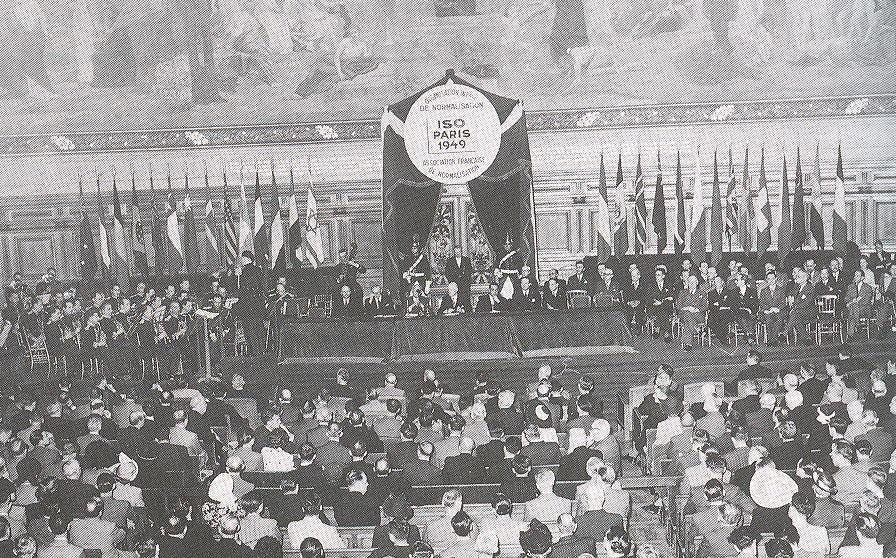
Seventy-seven years later, ISO returns to the city where it started to speak with one voice, in a year AFNOR itself celebrates its 100th anniversary, and in a very different global context.
Indeed in 1949, international standardization was a small, hopeful instrument of postwar reconstruction, the technical component to the newly built system of international institutions of the United Nations and Bretton Woods. In 2026, ISO is back to Paris as one of the last functioning pieces of the multilateral system, an organization still capable of getting China, Europe, the United States and more than a hundred developing economies to sit at the same table and agree on something concrete. An admirable achievement but one which is at risk.
The (extremely) underestimated importance of ISO
For about three decades, international standardization supported the Marrakesh Agreement that, in 1994, created the World Trade Organization (WTO), and the implementation of the Technical Barriers to Trade Agreement2 that followed a year later. It allowed a bolt made in Ohio fit a fixture made in Osaka, a quality management system certified in Sao Paulo be recognized in Stuttgart or a safety test run in Nairobi validated in Rotterdam.
Since its founding in 1947, ISO has helped translate technical cooperation into huge, tangible gains for people’s everyday lives: safer products, safer workplaces, more reliable food and healthcare systems, cleaner environments, greater consumer protection worldwide. By giving countries a common language, ISO standards have lowered trade barriers and transaction costs, fueling economic growth and job creation while helping developing economies access global markets and narrow the gap with wealthier nations.
As such, ISO standards have been, much too quietly, one of the fundamental enabling infrastructures of shared prosperity, supporting public health, environmental protection, and the reduction of poverty as much as industrial efficiency.
Standardization under pressure
The international order established after the Second World War is showing signs of unraveling.
Trade is fragmenting along bloc lines, protectionism and non-tariff barriers are multiplying (see Why a fragmented world rewrites the rules of standardization). Standardization, long considered as apolitical, has become an explicit arena of great-power competition. Some governments now treat standards strategy as a matter of national security and sovereignty (see Is it the end of the “One standard, one test, accepted everywhere” dream?). Others build parallel, opaque standard-setting arrangements outside ISO and IEC altogether, a kind of “shadow standardization” that answers to no one but its sponsors (see When standards go parallel).
None of this happened overnight but in 2026, at the precise moment where ISO’s Annual Meeting is taking place, this is something that is impossible to ignore.
ISO, a resilient organization
ISO’s entire value proposition is based on a function that nothing else, no bloc, no pluri- or bilateral agreement, and no private consortium, can replicate. It is the only place where adversarial countries still negotiate as equals over something that actually gets built, distributed, and used.
Historically, this function has survived the decolonization movement in the 1960s, the Cold War, the fall of USSR with direct substantial consequences on the membership and funding of ISO, China’s opening in 1978 and its rise to the ISO presidency by 2015, and the entry of the Global South into a majority position among ISO’s own membership.
Each of these events could have fractured the system. But none of them did, because the organization's members kept returning to the same principle: technical consensus is worth protecting even when political consensus is nonexistent.
Why Paris is key
This argument needs to be made loudly in Paris this year. Not as nostalgia for the age of “happy globalization” and frictionless trade, but as a deliberate choice about what to preserve while everything else is renegotiated.
The stakes are high. There is a significant risk that the economic, environmental and societal progresses to which ISO has strongly contributed are wiped out. It is important to remember that the moment international standards become just another battlefield for geopolitical leverage, the very efficiencies that they made possible will start to unwind, quietly and unevenly, with developing economies paying the first and highest price.
What ISO’s founders in 1946 and 1949 built endured not because it avoided politics, but because it refused to let politics dictate the content of standards. This is the discipline that Paris 2026 has to protect.
Building trust
The theme chosen for this year’s meeting, “Building trust in a changing world”, couldn’t be more relevant. It is a direct answer to the fragmentation that is now visible everywhere else in the international system.
As Swiss President Guy Parmelin explained this week in his address to the 81st session of the UN General Assembly, “Trust is built when the rules offer everyone a genuine opportunity to participate. It is also built when states continue to engage in dialogue”3.
If rules are what build trust, then who gets to shape them matters as much as the rules themselves. For ISO, concretely, this means ensuring:
That a genuine opportunity is given to all countries, including developing economies, to equally lead and contribute to the discussions and work at the ISO General Assembly, Council and governance groups, even if this calls for a redistribution of power and roles.
That the standards development process is not just said to be opened to everyone, but that each country or stakeholder interested in contributing, including SMEs, consumers, NGOs and other public society representatives, can actually sit at the table and can be heard.
That this same standards development process is capable of promptly responding to today’s stakeholders' needs.
That the new technologies and platforms currently deployed to write standards and to distribute their content also benefit the least advanced countries, not just a small group of privileged ones, and that every possible effort is made to decrease the gap that exists today between advanced and developing economies.
That new, open, simple and easy to understand copyright and commercial policies and strategies are deployed to make standards broadly and easily accessible to all users worldwide.
That regional organizations like ARSO, ASEAN, COPANT, GSO or RNF, in addition to CEN, are actively and equally supported as these organizations help build trust.
If ISO can leave Paris having reaffirmed that a standard is still something built together rather than imposed by the strongest group in the room, it will have done more for the multilateral order than most diplomatic summits held in recent years. If it cannot, the risk is not that ISO disappears, it is that it will slowly stop mattering, with decisions taken elsewhere, faster and with far less representativity and accountability. Seventy-seven years after the Sorbonne, Paris is the opportunity to remind the world what that discipline looks like in practice.
I wish all my former ISO colleagues and friends in National Standards Bodies a very successful Paris meeting!
Friendship Among Equals, ISO, 1997